


Delta State has reached the 35-year milestone with a development story shaped by institutional growth, infrastructure expansion, educational advancement, peace and an increasing drive towards economic diversification.
Created on August 27, 1991, from the former Bendel State, Delta has, over three and a half decades, evolved from a young administrative entity into one of the prominent economic and investment destinations in the Niger Delta.
The journey has been marked by contributions from successive administrations, each building on the foundations laid by its predecessors while introducing new policies, projects and opportunities.
From roads and bridges to universities, healthcare institutions, urban development and public infrastructure, the state has steadily expanded its capacity to serve its growing population and economy.
Ibru and the Foundations of a Young State
The administration of Delta’s first democratically elected governor, Chief Felix Ovudoroye Ibru, remains an important part of the state’s early development history.
Serving from January 1992 until November 1993, Ibru inherited a newly created state that was still developing its administrative identity and institutional structures.
His administration paid considerable attention to town planning and the orderly development of Asaba as the state capital, including the development of the Asaba Master Plan.
It also pursued programmes covering agriculture, rural development, transportation, education, healthcare, water supply, housing and town planning.
One of the administration’s most enduring achievements was the establishment of Delta State University, Abraka, in April 1992. The institution provided an important foundation for the state’s human-capital development and has since grown into a major centre of learning and research.
Building Modern Delta
The administration of Chief James Onanefe Ibori subsequently played a significant role in expanding infrastructure and institutional development.
Road and bridge projects, including the Ughoton–Omadino corridor, Ase River Bridge and Bomadi Bridge, improved connectivity and opened up previously difficult-to-access communities.
Attention to tertiary education and healthcare infrastructure also strengthened the state’s long-term development prospects.
Dr Emmanuel Uduaghan consolidated several of these gains through investments in infrastructure, healthcare, transportation and peace-building. The operationalisation of the Delta State University Teaching Hospital and the advancement of the Asaba International Airport further enhanced Delta’s institutional and economic profile.
Between 2015 and 2023, Senator Ifeanyi Okowa’s SMART Agenda broadened the development agenda to include infrastructure, education, healthcare, agriculture, skills acquisition, human-capital development, wealth creation and urban renewal.
The establishment of University of Delta, Agbor; Dennis Osadebay University, Asaba; and Delta State University of Science and Technology, Ozoro, expanded access to higher education and created additional platforms for developing skilled manpower.
Oborevwori and the MORE Agenda
Governor Sheriff Oborevwori, who assumed office in 2023, has continued the development trajectory through the MORE Agenda — Meaningful Development, Opportunities for All, Realistic Reforms and Enhanced Peace and Security.
The administration has focused on infrastructure delivery, completion of viable inherited projects, fiscal responsibility, human-capital development and institutional strengthening.
Major road, bridge, drainage, urban renewal and transportation projects have remained central to the administration’s development programme.
The Warri-Effurun, Agbor and Ughelli flyover projects are among the interventions aimed at improving mobility and strengthening economic connectivity.
Investment Takes Centre Stage
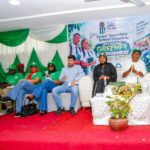
A major component of the state’s current economic strategy was the Delta State Economic and Investment Summit held in Asaba from August 3 to 5, 2026, under the theme, “Harnessing Our Strengths, Unlocking Our Potential.”
The summit brought together government representatives, investors, business leaders, development partners, financial institutions and other stakeholders to explore opportunities across agriculture and agribusiness, energy, the blue economy, transport infrastructure, digital economy, innovation, solid minerals and the Delta Special Economic Zone.
Governor Oborevwori announced a $100 million Viability Gap Fund aimed at helping to de-risk new investments in the state, while more than 12,000 hectares of farmland were earmarked for agricultural development.
The initiatives point to an effort to move Delta from merely possessing economic potential to creating bankable opportunities capable of attracting private-sector investment.
Looking Beyond Oil
At 35, Delta’s development conversation is increasingly shifting towards diversification.
Agriculture, energy, logistics, manufacturing, technology, transportation, the blue economy, solid minerals, tourism and the creative economy all offer opportunities for expanding the state’s economic base.
The objective is to build an interconnected economy where infrastructure facilitates trade, education supplies skills, agriculture feeds industry, technology drives innovation and investment creates employment.
As Delta marks its 35th anniversary, the state’s achievements provide grounds for celebration, while the emerging investment agenda offers a basis for renewed optimism.
The first 35 years laid the foundation. The challenge and opportunity ahead are to convert that foundation into sustained economic strength, expanded opportunities and shared prosperity.
Fred Latimore Oghenesivbe, Esq., is the Director-General of the Delta State Bureau for Orientation and Communications, Governor’s Office Asaba. He’s a member of the Association of Communication Scholars and Professionals of Nigeria (ACSPN).