




The reported insistence by Primate Julius Olayinka Osayande Abbe on completing his tenure has emerged as a major challenge to reconciliation efforts within The African Church.
The issue has reportedly triggered strong reactions among members of Uyo Province, with some questioning whether the Church can achieve lasting peace while the current leadership arrangement remains unchanged.
The development comes after an extended period of disagreement involving questions of authority, disputed decisions, contested elections, court actions and competing interpretations of the Church’s constitutional provisions.
Reconciliation at a Crossroads
The Reconciliation Committee is now confronted with a difficult task.
On one side are those who argue that Primate Abbe’s tenure should be respected and completed in accordance with the relevant constitutional provisions.
On the other side are members who believe that the leadership crisis has become too deeply entrenched around the current leadership and that a transition may be necessary to rebuild confidence.
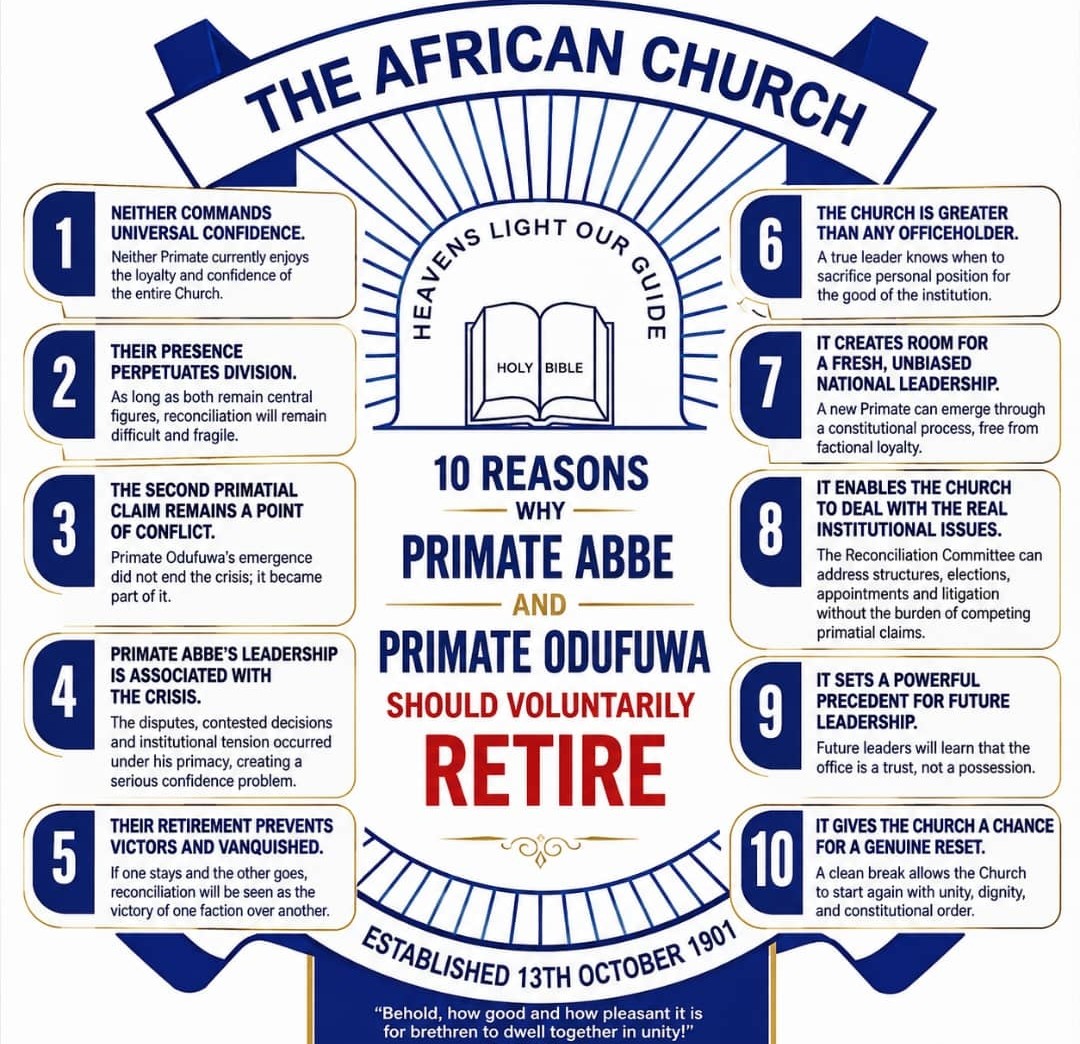
The latter group reportedly favours voluntary retirement rather than disciplinary removal.
They argue that stepping aside voluntarily would enable the Primate to preserve his dignity while making a major contribution to institutional peace.
Why Uyo Province Matters
The reaction from Uyo Province has added weight to the debate because members there are reportedly demanding a comprehensive solution.
They are said to be concerned that allowing Primate Abbe to complete his tenure could merely defer the central leadership dispute.
Some have consequently suggested that both Abbe and Primate Afolabi Odufuwa should consider voluntary retirement.
The proposal would pave the way for a fresh leadership process based on constitutional requirements rather than factional calculations.
Avoiding Another Leadership Dispute
There are also concerns that any reconciliation agreement could become a mechanism for distributing offices among competing factions.
Members opposed to such an approach insist that the future national leadership of the Church should be determined by constitutional eligibility and other objective considerations.
Competence, integrity, experience and the capacity to unite the Church, they argue, should be more important than factional allegiance.
A Defining Moment
The current situation has placed the Reconciliation Committee at a defining point.
Its recommendations could either restore confidence in the Church’s institutions or deepen existing divisions if members perceive the outcome as favouring one side.
For ordinary worshippers, the priority is reportedly peace and stability.
Many members want an end to competing leadership claims and a return to a Church where constitutional procedures are respected and worshippers are not compelled to choose sides.
The coming decisions will therefore be closely watched by members across the Church.