

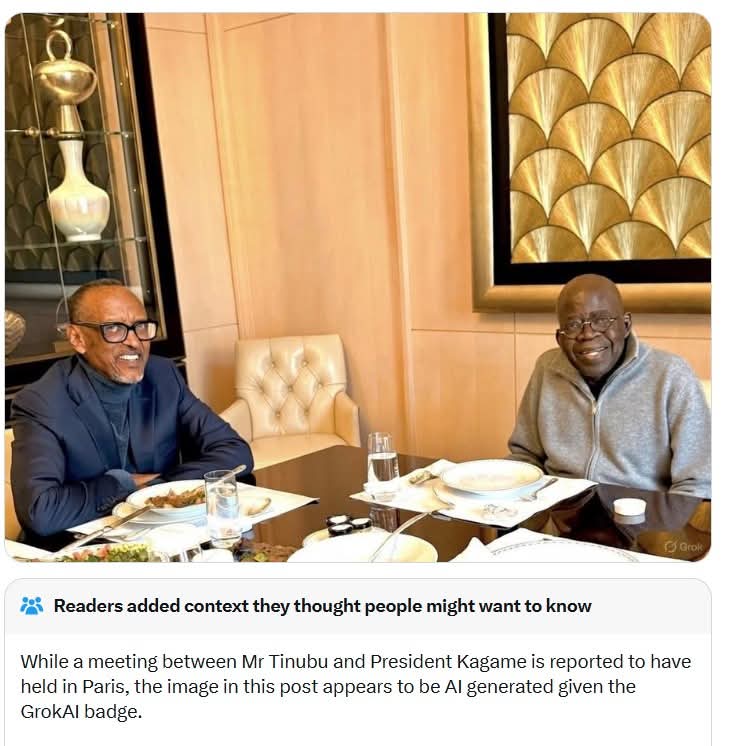
“Tinubu’s AI Blunder: Doctored Kagame Lunch Pic Ignites Firestorm Online
President Bola Tinubu of Nigeria is facing questions over the authenticity of a photograph he shared online, purporting to show him dining with Rwandan President Paul Kagame in Paris.
The image, posted on Sunday, depicts the two leaders at a private lunch table laden with food and drinks, and carries a prominent watermark from Grok, an AI image generator created by Elon Musk’s xAI.
US Ambassador to South Africa Resigns Following Trump’s Presidential
Experts who examined the photo for the BBC confirmed telltale signs of AI generation, including unnatural lighting on the figures’ faces, inconsistent shadows, and overly symmetrical facial features typical of tools like Grok.
The post emerged amid Tinubu’s reported trip to Paris for medical treatment, raising initial expectations of diplomatic engagements but now sparking debate over transparency in Nigerian official communications.
Bayo Onanuga, Tinubu’s special adviser on information and strategy, first announced the meeting on Facebook, describing it as a discussion on “global affairs, Africa’s position in the evolving international order, and our shared vision for the continent’s development.
“Tinubu himself amplified the claim on X, formerly Twitter, writing: “This afternoon, I had a private lunch with H.E. President Paul Kagame of Rwanda to discuss the current state of world affairs and advancing Africa in an ever-changing global landscape.
“He attached the now-disputed image, which was quickly reposted by Dada Olusegun, the president’s special assistant on new media, reaching thousands of followers across platforms.
Neither the Nigerian presidency nor Rwanda’s government has confirmed the meeting took place, despite BBC requests for comment sent to both offices on Sunday evening.
A spokesperson for the Rwandan presidency told the BBC they had “no record of President Kagame being in Paris on 4 January,” casting further doubt on the encounter.
Attempts to verify Tinubu’s location independently proved challenging; his office cited medical privacy but provided no itinerary, while Paris hotel records and flight manifests, checked via public sources, yielded no matches.
Digital forensics experts, including those from the BBC’s Verify unit, ran reverse image searches and AI detection algorithms, which scored the photo over 95% likely generated, with the Grok watermark unaltered.
This is not the first time world leaders have faced backlash over AI imagery; in 2023, US President Joe Biden’s team admitted using altered photos, prompting global guidelines on digital authenticity from tech firms.
Nigerian social media erupted with criticism, users labelling it a “national embarrassment” and demanding sackings, with hashtags like #TinubuAI and #FakeLunch trending locally.
Prominent voices, including opposition figure Peter Obi, called for an investigation, tweeting: “Authenticity matters in leadership, AI cannot replace real diplomacy.”Critics argue the incident undermines trust in Nigeria’s government at a time of economic strain, with polls by local firm NOI showing public faith in official statements already at a low 32%.
Supporters of Tinubu counter that the image was merely illustrative, pointing to Onanuga’s history of sharing conceptual visuals without disclaimers.
The presidency has yet to respond directly to the AI claims, but sources close to Onanuga say an internal review is underway, potentially leading to a clarification by Monday.
As AI tools proliferate, experts warn of a “post-truth” era in politics, urging watermarks and metadata standards, recommendations echoed in a 2025 UN report on digital verification.
For now, the episode leaves unanswered whether the lunch occurred, highlighting Nigeria’s challenges in balancing rapid communication with verifiable facts.