


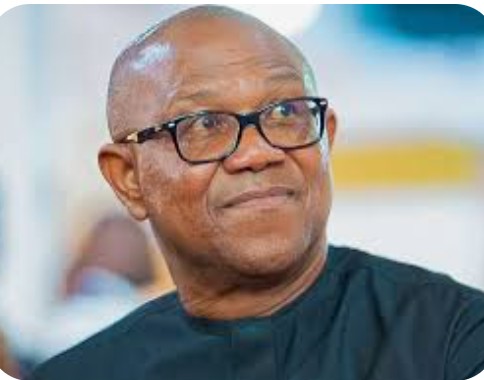
How Peter Obi’s Defection Exposed Deep Cracks In Labour Party
…..As Obi, Otti Slammed for Fueling Insurrection Against Party Brass
The Labour Party has described the defection of its 2023 presidential candidate, Mr Peter Obi, to the African Democratic Congress (ADC) as a “liberation” for the party, in a development that underlines deep-seated internal battles, power struggles and mutual accusations that have plagued the party since the 2023 general elections.
In a strongly worded statement signed by its National Publicity Secretary, Obiora Ifoh, and dated December 31, 2025, the party not only welcomed Obi’s exit but also tendered what it called a “public apology” to Nigerians for fielding him as its presidential flag bearer in 2023, describing that decision as “the greatest political mistake” in the party’s history.
The statement, which has further polarized opinion within the party and across the wider opposition landscape, also accused Obi and Abia State governor, Dr Alex Otti, of allegedly sponsoring an “insurrection” against the leadership of the party’s National Chairman, Julius Abure.
Mr Obi, who emerged as the surprise third force in the 2023 election after leaving the Peoples Democratic Party (PDP) for Labour Party in May 2022, formally announced his defection to the ADC at an event in Enugu attended by some of his supporters and a small coalition of political actors.
The Labour Party, in its reaction, claimed it had “since September 2024” effectively parted ways with Obi and some of his allies, including lawmakers in the National Assembly, over what it described as “anti-party” activities and refusal to work with the Abure-led National Working Committee (NWC).
According to the statement:“We have since September 2024 parted ways with Peter Obi and some of his blind supporters in the National Assembly. We have patiently waited for this day. The party is finally liberated by this defection and as party leaders, we count it as a blessing.”
Party insiders who spoke to our correspondent on condition of anonymity said the relationship between Obi and the party leadership had broken down shortly after the 2023 election petitions were concluded, with disagreements over control of party structures, finances, and the direction of post-election opposition politics.
One senior party official said: “There was a constant tug of war over who owns the party, the founders and structures, or the new wave that came with Obi. After the elections, that question became impossible to ignore.”
However, close associates of Mr Obi contacted by our correspondent dismissed the Labour Party’s account as “revisionist” and “spiteful,” insisting that the former candidate left over “irreconcilable differences on values, transparency and internal democracy.”
At press time, Obi had not issued a detailed personal response to the specific allegations made by Labour Party’s publicity secretary.
In its statement, Labour Party claimed that several lawmakers loyal to Mr Obi had been suspended for alleged anti-party activities and that the party had “considered” similar disciplinary measures against Obi himself, but refrained after what it described as the intervention of “some well-meaning Nigerians.”
The statement reads in part:“It will be on record that the leadership of the Labour Party had since urged Obi and his disgruntled followers to exit the party if they were unable to work with the leadership of the party.
The party had suspended many of the lawmakers for anti-party and was clearly going to mete the same treatment on the Presidential Candidate but for the intervention of some well-meaning Nigerians.
”Independent verification of the full list of suspended lawmakers and the specific charges against them proved difficult. Some legislators said to have been affected insist they were never given fair hearing, alleging that the Abure-led NWC ran the party “like a closed shop.”
The crisis in Labour Party reached a peak in 2023 and 2024 when rival factions emerged, with court cases, conflicting ward and state congresses, and accusations of forged documents and parallel conventions.
Political analysts told this our correspondent that the open denunciation of a former presidential candidate by his own party leadership is rare in Nigeria’s Fourth Republic.
A political scientist at the University of Nigeria, Nsukka, Dr. Chidinma Okoro, said: “It is unprecedented for a party to publicly apologize to Nigerians for fielding its most successful presidential candidate in history. It reflects how bitter and entrenched the internal disputes have become.”
The Labour Party statement also turned its fire on Abia State governor, Dr Alex Otti, alleging that he and Obi “sponsored the insurrection” against the party’s national leadership.“ The crisis we had in Labour Party was caused by Peter Obi and the Abia State governor, Dr Alex Otti. It was them that sponsored the insurrection against the Julius Abure leadership,” the statement claimed, without providing documentary evidence.
The party added that it had “suspended” Governor Otti and questioned why he had not also announced his defection.“We had also expected Governor Otti to follow Obi out of the party. We are surprised that even though he has been suspended from the party, he is still loitering around. It is still not too late for him to follow his political leader.”
Efforts to obtain a reaction from Governor Otti’s media team were unsuccessful as at the time of filing this report. One senior Abia government official, however, described the allegations as “laughable and politically motivated,” arguing that the Labour Party leadership “fears losing its last remaining showcase governor.”
Legal experts say the claim of Otti’s suspension raises separate questions about the authority of the current NWC, given the multiplicity of court rulings and interim orders affecting the party’s leadership since 2023.
Labour Party also dismissed the Enugu event where Obi’s defection was formalised as a “charade,” claiming that prominent political and traditional institutions in the South East “largely boycotted” the event.
According to the statement:“All we saw were mere political spent forces who cannot win in their wards should there be an election today.
This is clearly a danger signal that the Obi presidency (or Vice Presidency) is already a failed project from inception.
He has clearly lost the charm that had endeared him to the people prior 2023.”
Checks showed that while attendance at the Enugu rally appeared lower than Obi’s peak-momentum events in 2022–2023, several notable politicians, youth groups and civil society organizations were present.
However, the presence of top-ranking traditional rulers and sitting governors from the zone was noticeably thin.
A former federal lawmaker from the region, who asked not to be named, said:“Many of the elite are now cautious. They are watching where the wind is blowing in Abuja and within the opposition.
Some don’t want to openly align with Obi until they see how his new platform shapes up.
”Independent confirmation of the Labour Party’s characterization of attendees as “spent forces” is not possible, as that description is opinion rather than verifiable fact.
Political observers say such language underscores the bitterness of the split rather than providing a factual assessment of Obi’s current standing.
In one of the more consequential political claims in the statement, Labour Party blamed Obi for what it described as the South East’s marginalisation in President Bola Ahmed Tinubu’s administration, arguing that the region “lost out completely” because it “trusted and believed in him in 2023.”The statement reads:
“He must be told that the South East lost out completely in the President Ahmed Tinubu’s government because they trusted and believed in him in 2023. While some states of the federation boast as much as five ministers, the entire states in the South East was given a paltry five ministerial slot.
The marginalization against the zone has continued even in infrastructure allocation and I wonder if the Southeast will repeat the same political harakiri again.
”An examination of ministerial appointments and top federal postings suggests that the South East has, as in previous administrations, raised concerns of underrepresentation. However, constitutional requirements and the prerogative of the president in appointments make it difficult to attribute the final distribution solely to voting patterns or support for specific candidates.
A Lagos-based public affairs analyst, Mr. Abdulrahman Sani, said:“Every election cycle, each region backs one candidate or another and then negotiates afterwards. To say the South East ‘lost out completely’ because of Peter Obi simplifies a more complex issue. At the same time, there is no doubt that the region’s voting pattern and the perception of opposition to the ruling party shape political calculations in Abuja.”
The Presidency has consistently denied that any geopolitical zone is being deliberately marginalised, insisting that appointments and projects are based on merit, competence and national interest.
Perhaps the most explosive portion of the statement is Labour Party’s direct plea for forgiveness from Nigerians, in which it openly regrets presenting Obi as its presidential candidate in 2023.
“Finally, we urge Nigerians to watch out for the Labour Party. We gave Nigerians a candidate we thought was good for the nation in 2023, but time has since proved that we made the greatest political mistake.
We plead for forgiveness from Nigerians. We are already working out the best prospect that we hope will bring Nigeria back to its glorious days.”This admission marks a sharp reversal from the party’s pre- and post-election posture, when Obi was presented as the face of a new political movement and the party pursued litigation up to the Supreme Court, insisting he had won or at least performed strongly enough to warrant a rerun.
Critics of the current party leadership argue that the apology is less about principle and more about discrediting Obi ahead of 2027, when he is widely expected to make another run for the presidency under a different platform.
A former Labour Party national officer, who has now aligned with Obi, said:“When they were benefiting from his popularity, they said he was the best thing that happened to Nigeria. Now that they are threatened by his continued relevance outside their control, suddenly he is their ‘greatest mistake’.
Nigerians can see through that.”What Next For Labour Party And Obi?
With Obi now formally in the ADC, Nigeria’s opposition landscape faces a period of realignment.
The Labour Party must confront its internal divisions, rebuild structures, and convince both its core base and the wider electorate that it remains a credible platform separate from Obi’s personal brand.
The party, through its spokesperson, insists it is already working on “the best prospect” for future elections, hinting at new alliances and possible fresh faces who could emerge as presidential material.
Conversely, Obi’s political future now depends on whether he can replicate or sustain the enthusiasm of the “Obidient” movement outside Labour Party, whether the ADC has the national spread and structure to support a presidential bid, and whether the broader opposition can unite around a common front against the ruling All Progressives Congress (APC).
Analysts say the open war of words between Obi and his former party could complicate any attempt at a grand opposition coalition.“Nigerian opposition politics has a long history of fragmentation,” Dr Okoro observed.
“What we are seeing is that personal grievances, ego battles and control of party structures are again threatening to undermine any serious challenge to the ruling party in 2027.” For now, the Labour Party’s statement has thrown more light on the scale of the rupture within the party while raising fresh questions about internal democracy, accountability, and the durability of political alliances built around personalities rather than long-term institutional structures.
As Nigerians weigh the party’s apology, the allegations against Obi and Governor Otti, and the broader claims of marginalisation and miscalculation, one thing is clear: the battle for the soul of the opposition ahead of 2027 has only just begun.